In90 s
moulded at home
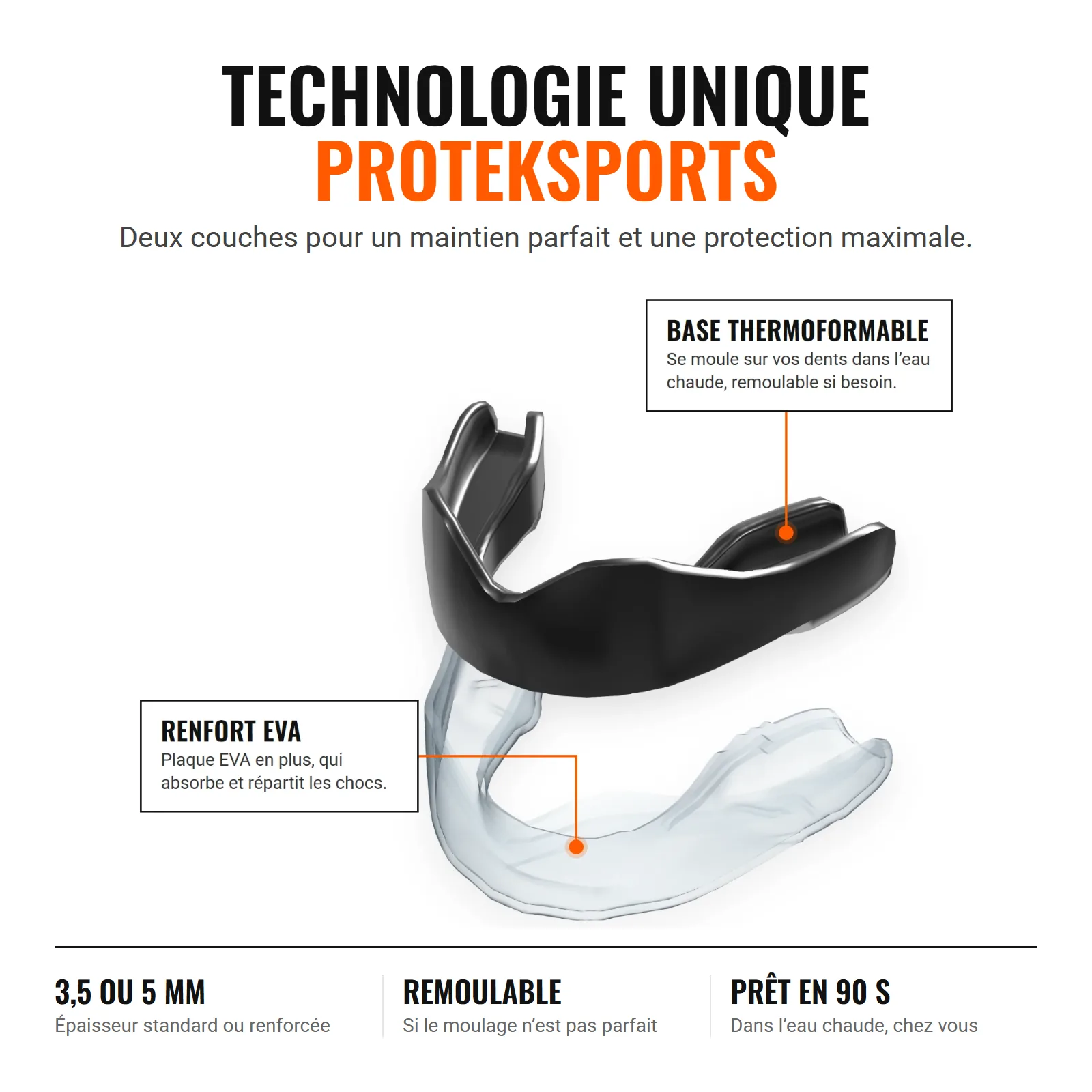
30 seconds in water at 80 °C, 30 seconds of biting, 30 seconds in cold water: it moulds to your teeth, with no appointment and no impression kit.
Get protected straight away, thanks to quick moulding at home.
You mould it yourself, in 90 seconds.
Ready to mould, with its instructions. No appointment, no impression kit.
Hot, not boiling water (around 80 °C). It becomes soft.
On your upper teeth: bite down firmly, it takes their shape.
It hardens: it’s ready. Not perfect? It can be remoulded.
Practical
In90 s
30 seconds in water at 80 °C, 30 seconds of biting, 30 seconds in cold water: it moulds to your teeth, with no appointment and no impression kit.
100 %
Moulding didn't work? Start again: put it back in the hot water and remould it until you get a stable, comfortable fit.
Up to2 years
With a rinse after every use and storage in a ventilated case, for regular training and sparring.
Moulding according to the instructions provided: water at ~80 °C, 30 s heating, 30 s biting, 30 s in cold water. Indicative lifespan with regular care.
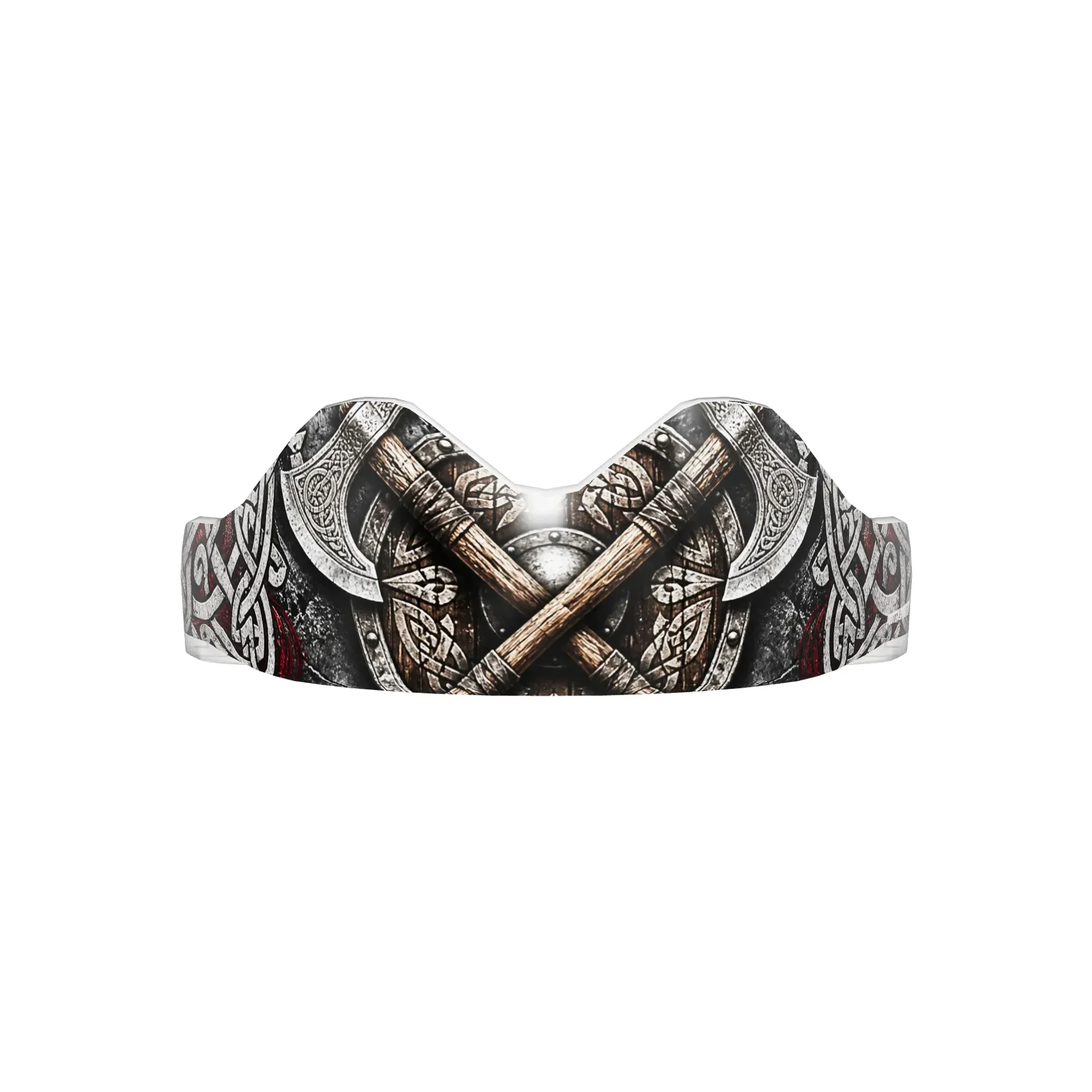
This Celtic Axes Boil-and-Bite Mouthguard places two crossed axes at the centre of dark Celtic knotwork with metallic highlights. The sharp contrast conveys a cutting, warlike and disciplined energy.
Once properly moulded, the boil-and-bite version adapts to your teeth to provide hold and easy breathing during exertion. Its EVA absorbs impacts and carries the Viking design in practical, remouldable protection that lasts with regular care.
The boil-and-bite (thermoformable) mouthguard is a practical solution for athletes who want affordable protection that is quick to prepare and suited to training as well as competition.
Two thicknesses are available: 3.5 mm and reinforced 5 mm.
In the centre, two long-bladed axes cross in front of a round studded shield. The hafts are rough wood, and the grey heads bear engraved knotwork. The whole thing sits on a black background that brings out the metal.
The sides change register. Broad silver-white knots, with the look of worn stone, run across a dark red and black background. It is the design’s only touch of colour, and it shows as soon as you smile.
These knots with no beginning or end are a decoration common to the Celtic and Scandinavian arts of the early Middle Ages; they are found on carved stones, jewellery and weapons. The axe, for its part, was the everyday weapon of Northern fighters, cheaper than a sword. This mouthguard suits boxers, MMA fighters and rugby players who prefer crisp graphics to a portrait. It goes with black, red, burgundy and grey, and pairs very well with red gloves.
Rinse it in cold water after each use.
Clean it gently with a brush and a mild toothpaste, then let it dry before storing it in its ventilated case.
Lead time: Ships within 3–5 days (variable lead time).
Your parcel leaves as soon as your order has been prepared.
Free tracked delivery on orders from €39. Below that, delivery costs €1.90 in France and €2.90 to other countries.
A tracking number is sent to you by e-mail when your order ships.
Returns: as this product is custom-made or printed to order, it cannot be refunded under the right of withdrawal. Statutory guarantees still apply.
These reviews reflect personal experiences. Proteksports offers mouthguards designed to support athletes in their sport.
143 Proteksports reviews, all products
Maxime R.
Verified
Excellent
Best value for money on the market. Go for it.
 Classic Boil-and-Bite Mouthguard
Anthony D.
Verified
Thanks to the team
Responsive customer service and great product. Free delivery much appreciated.
 Personalised Boil-and-Bite Mouthguard
Thomas C.
Verified
Not disappointed
Got it for rugby, it protects well against knocks.
Classic Boil-and-Bite MouthguardSebastien F.
Verified
Breathing
I breathe much better than with my old one. The thinness changes everything.
 Classic Custom-Fit Mouthguard
Amel B.
Verified
A must, super comfortable and performs really well. thanks
 Personalised Custom-Fit Mouthguard
It is a Viking mouthguard with a Celtic axes design, with no official symbol. This model is still a sports mouthguard: it does not replace safety rules or a professional assessment after an injury.
Both traditions used this decoration of knotted ribbons. The Celts of the British Isles developed it in stone and manuscripts, the Scandinavians in wood and metal, and the styles blended as the two came into contact. The name of the design keeps the Celtic heritage.
No. It is a dark red, close to burgundy, placed behind the silver-white knots. From the front, you mostly see the black, the grey of the axes and the brown of the hafts. The red appears on the sides, level with the premolars and molars, as an accent of colour.